



With electricity prices, energy security and the transition to renewable generation emerging as key issues in the 2026 election, the major parties are offering very different ideas about how New Zealand should produce, regulate and pay for its power.
With New Zealanders heading to the polls on 7 November, energy policy has become an increasingly important part of the election debate.
The parties broadly agree on one thing: New Zealand needs more electricity and cheaper electricity.
Where they differ is on how that should happen, what role fossil fuels should play, how much government should intervene in the electricity market — and what can be done to bring down household power bills.
Here is a quick look at the major parties' positions.
National: More generation, competition and consumer choice
National's energy platform is centred on increasing electricity supply, encouraging private investment and giving consumers more choice.
Its Electrify NZ 2.0 plan includes measures to make it easier and faster to build renewable generation and transmission infrastructure, open up competition around electricity connections and allow households with solar or batteries to sell their excess electricity to whichever power company offers the best deal.
National also wants affordability to become an explicit objective for the Electricity Authority, alongside competition, reliability and efficiency.
For households, one of the more direct proposals is a Home Energy Fund, providing long-term loans for measures such as solar panels, batteries and insulation. National also wants small-scale renewable generation to face fewer planning restrictions.
The party is also backing additional security of supply, including domestic gas development and an LNG import facility to provide backup during periods when hydro generation is constrained.
The National approach: build more generation, remove barriers to investment, increase competition and use a mixture of renewable generation and backup supply to improve security and affordability.
The Power Compare approach: Compare your power bill NOW to save - don't wait for new policies! Compare Power Plans here.
Labour: Solar, consumer protection and cheaper household energy
Labour is putting greater emphasis on helping households generate their own electricity and protecting consumers from excessive prices.
Its headline energy policy is SolarSaver, a $160 million programme designed to remove the upfront cost of installing solar.
The scheme would provide government-backed, long-term finance, subsidies of up to $3,000 for eligible households, support for renters through plug-in solar and funding for community batteries.
Labour also proposes giving households a fairer return when they export electricity to the grid through better solar buy back rates.
The party has separately promised to make price gouging illegal, including excessive pricing for essential services such as energy. The Commerce Commission would receive new powers to investigate and take action against large companies with significant market power.
Labour has also said it would restore a ban on new oil and gas exploration, putting it at odds with the Government's current approach to domestic gas supply.
The Labour approach: help households reduce their bills through solar and electrification while giving regulators stronger powers to tackle excessive pricing.
The Power Compare approach: Compare your power bill NOW to save - don't wait for new policies! Compare Power Plans here.
Greens: Kiwipower and a bigger role for government
The Green Party is proposing the most significant structural change to the electricity market.
Its central policy is the creation of Kiwipower, a publicly owned energy company that would invest in new renewable generation and provide backup capacity to help address New Zealand's dry-year electricity problem.
The Greens argue that the existing market has failed to deliver affordable and secure electricity and that greater public ownership is needed.
The party is also proposing zero-interest loans covering up to 90% of the cost of household clean-energy investments, support for community-owned renewable projects, more solar on public housing and a "right to solar" for renters.
The Greens would also seek to ensure households and businesses with rooftop solar receive a fair price for electricity exported to the grid.
They oppose the Government's planned LNG import facility, arguing that New Zealand should instead invest in renewable generation and alternative forms of firming.
The Green approach: more public ownership, substantially more renewable generation, household solar and batteries, and less reliance on fossil-fuel backup.
The Power Compare approach: Compare your power bill NOW to save - don't wait for new policies! Compare Power Plans here.
ACT: Let the market build more power
ACT's approach is focused on removing regulatory barriers and encouraging private investment rather than restructuring the electricity industry.
The party wants households to have greater freedom to generate and sell electricity, including being able to sell solar power to a company other than their existing retailer. Read more on their policy here.
ACT also wants more competition around electricity connections and transmission, including allowing private investors to build and operate transmission infrastructure where appropriate.
The party wants lines companies to demonstrate that major network upgrades are worthwhile before the costs are passed on to consumers.
ACT opposes breaking up the major electricity generator-retailers and instead argues that competition should be increased by making it easier for new generation and new competitors to enter the market.
The party also supports keeping the door open to gas and other forms of firm generation while more renewable capacity is developed.
The ACT approach: reduce regulation, encourage private investment, increase generation and network competition, and rely on market forces rather than structural government intervention.
The Power Compare approach: Compare your power bill NOW to save - don't wait for new policies! Compare Power Plans here.
New Zealand First: Break up the big power companies
New Zealand First is proposing one of the most dramatic changes to the structure of the electricity market.
Its Power to the People policy would separate the major electricity generators from their retail businesses.
The party argues that the major generator-retailers have too much control over both electricity generation and retail pricing, making it harder for smaller retailers to compete.
New Zealand First wants a National Energy Strategy, long-term fixed-price contracts for new generation and changes designed to prevent generators withholding supply.
It also proposes that households generating electricity from solar should be able to sell it back to the grid at the same price they pay when buying electricity.
The party's focus is strongly on energy security, industrial competitiveness and reducing the influence of the large electricity companies.
The NZ First approach: restructure the electricity industry, increase competition and supply, and put greater emphasis on energy security and consumer prices.
The Power Compare approach: Compare your power bill NOW to save - don't wait for new policies! Compare Power Plans here.
Opportunity: A major renewable build-out
The Opportunity Party is proposing a substantial increase in New Zealand's electricity generation capacity, with a target of reaching 30GW of total capacity by 2050.
Its plan includes a new capacity investment scheme designed to attract private investment into renewable generation and support for businesses to electrify their operations.
Opportunity also wants significant changes to the way the electricity sector is regulated, including combining the existing energy regulators and reducing the number of electricity distributors.
It would introduce low-interest loans to help households electrify and is opposed to the Government's proposed LNG import facility.
The Opportunity approach: accelerate renewable generation, reform the electricity market and invest in electrification rather than expanding fossil-fuel infrastructure.
The Power Compare approach: Compare your power bill NOW to save - don't wait for new policies! Compare Power Plans here.
So what does it mean for your power bill?
The parties are offering different routes to broadly the same political goal: more affordable and more reliable electricity.
The biggest differences are around who should provide the investment and how the market should work.
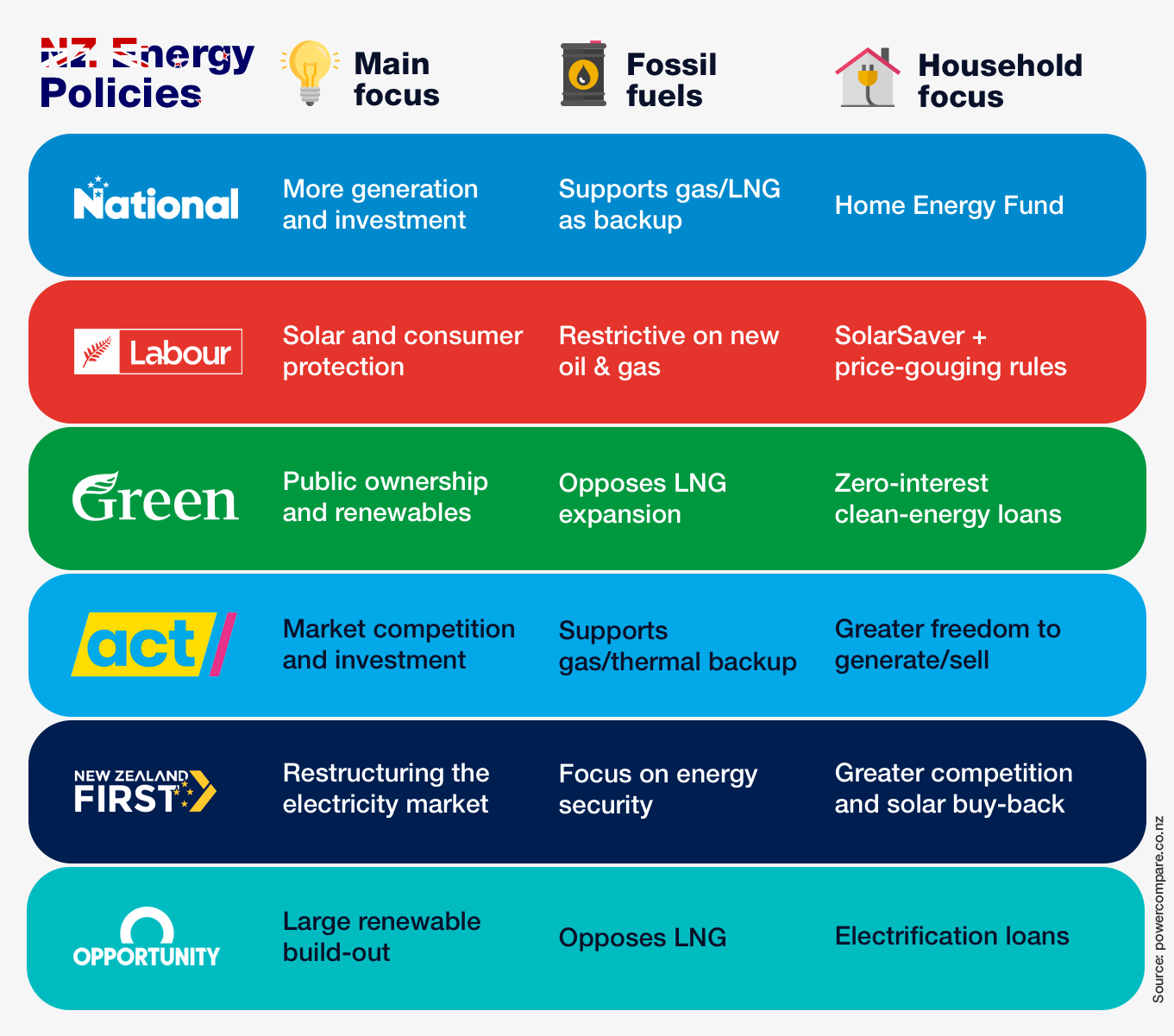
For electricity consumers, the important question may ultimately be less about the headline generation targets and more about how each policy affects the cost of generation, transmission, distribution and retail electricity.
More renewable generation could put downward pressure on wholesale prices over time, but the country will still need enough firm generation or storage for dry years and periods of low wind and solar output.
And regardless of who wins the election, investment in the electricity network will remain important as New Zealand electrifies more homes, vehicles, businesses and industry.
The Power Compare approach: Compare your power bill NOW to save - don't wait for new policies! Compare Power Plans here.
The bottom line
There is broad political agreement that New Zealand needs more electricity. There is much less agreement about how to get there.
National and ACT favour greater private investment and fewer regulatory barriers. Labour is focusing on household solar and stronger consumer protections. The Greens want a new publicly owned generation company. NZ First wants to restructure the major electricity companies, while Opportunity is proposing a major renewable generation and market-reform programme.
For households, the election could therefore have consequences well beyond the next power bill — potentially influencing how much new generation is built, how quickly renewable energy expands, the role of gas in the electricity system and how consumers are protected from rising costs.
With power prices a major cost for Kiwi households, the energy policies of the next government will be worth watching closely.
...and in case you missed our approach to all this?
Compare your power bill NOW to save - don't wait for new policies!
Visit Power Compare